Democratizing Strategic Intelligence: The PSYing Multimodal RAG Architecture for Universal Existential Literacy
About the Authors
Filippo Bartoccioni, MD, PhD, MBA, is a Professor and Lead Scientific Architect specializing in the convergence of neurobiology and strategic intelligence. He is the primary inventor of the PSYing ecosystem, with the software and proprietary ontology officially registered under his authorship at the Italian Society of Authors and Publishers (SIAE). His research focuses on "Existential AI Literacy" and the development of specialized RAG architectures for strategic decision support and systemic resilience.
Mihaela Dubinski is the CEO of COM srl, the organization responsible for the technological deployment and industrialization of the PSYing ecosystem. She directs the integration of complex digital infrastructures and ensures that the platform adheres to international data governance standards and strategic operational requirements for C-level decision-making.
Main Scientific Contribution in One Paragraph
The PSYing project serves as the digital evolution of the PSYing book series, introducing a new framework called "Existential AI Literacy." This approach uses artificial intelligence not as a simple search engine, but as a strategic mentor that helps users apply the book’s teachings to their own lives. Unlike standard chatbots that often provide generic or evasive answers, PSYing is strictly anchored to the book’s proprietary knowledge, utilizing an English-centric "brain" to ensure high-level reasoning across 16 different languages. The system is truly multimodal: it understands voice notes, processes images, and even considers the specific time of day you reach out (the Kairos Protocol) to turn emotional blocks into clear action plans. Safety is built into its core; if the system detects signs of physical distress, it cross-references the "Terapia 2026 Manual" and immediately directs the user to a medical professional. By using the familiar Telegram interface, PSYing democratizes access to high-level strategy, making personal resilience and growth accessible to everyone, regardless of their background. Operational transparency is guaranteed through the research hubs at www.psying.education and t.me/PSYingBot.
Abstract
Today’s generative AI suffers from a double failure: it either tells you exactly what you want to hear, reinforcing your own biases, or it censors "difficult" topics, making it impossible to explore the deeper parts of the human experience. We introduce PSYing-a 16-language ecosystem built to be an "Incorruptible Witness." Directly powered by the proprietary knowledge of the PSYing book series, this AI acts as a digital mentor that isn't afraid to challenge the user's defensive logic.
The system uses a sophisticated English-centric engine to ensure deep reasoning that standard chatbots cannot match. It features a unique "Semantic Bypass" that allows for the safe exploration of dreams and intense emotions—areas that commercial AIs typically block—while maintaining strict ethical boundaries. A major innovation is the Kairos Protocol, which tracks the time of day to ensure the AI understands the difference between a mid-day work challenge and a 3:00 AM anxiety peak. By analyzing not just text, but also the tone of your voice and the images you share, PSYing captures emotional cues that traditional AI misses.
Safety is at the heart of the architecture; the system includes a built-in check anchored in the Terapia 2026 manual to identify physical health risks and mandate medical intervention when necessary. By offering this high-level strategic mentoring at an affordable rate through a simple Telegram interface, we are democratizing personal growth—making elite-level tools accessible to everyone, from top executives to the general public.
Operational transparency and research data are available at www.psying.education and t.me/PSYingBot.
Abstract for the Interdisciplinary Author (Max 120 words)
Standard artificial intelligence typically fails to navigate human complexity, defaulting to shallow validation. PSYing addresses this as a high-frequency training environment for universal strategic empowerment, utilizing an English-centric backend for maximal semantic depth. This multimodal architecture processes text, audio, and visual triggers via the "Kairos Protocol" for chronometric awareness. Its vocal-first design ensures accessibility for users regardless of technical or socio-economic background. Crucially, the system maintains a rigid safety threshold: upon identifying physical symptoms, it cross-references the "Pocket Manual Terapia 2026" via a Cross-RAG Understanding and mandates medical consultation. It serves as a democratic strategic compass, decoding systemic patterns and vocal nuances to transform complex emotional noise into actionable intelligence for all.
Keywords
Multimodal Artificial Intelligence; RAG Architecture; Decision Support Systems (DSS); Existential AI Literacy; Strategic Mentoring AI; SIGN Protocol; PSYing; Affective Computing.
Beyond "Common Sense": Why This Paradigm is Vital Today
The current landscape of generative artificial intelligence is defined by a "Compliance Crisis." Most Large Language Models (LLMs) are architected for user satisfaction, resulting in a systemic bias frequently identified as "AI Euphoria." This pervasive tendency toward optimistic validation and polite agreement renders standard models ineffective for high-stakes strategic decision-making, where the primary requirement is not affirmation, but rigorous cognitive friction. For C-level executives, negotiators, and leaders, a tool that merely echoes their defensive rationalizations is a strategic liability.
PSYing disrupts this paradigm by establishing the "Existential AI Literacy" framework, a decisive pivot away from clinical therapy toward a purely formative and strategic orientation. Unlike standard conversational assistants, PSYing is engineered to function as an "Incorruptible Witness." This is achieved through the 16-language multimodal architecture supported by an English-centric backend, ensuring that complex semantic reasoning remains consistent across global linguistic inputs.
A critical differentiator of this infrastructure is the "Kairos Protocol"—a chronometric awareness system that processes timestamped metadata to identify circadian fluctuations in user anxiety and cognitive load. By distinguishing between a high-noon strategic inquiry and a 3:00 AM nocturnal anxiety loop, the system provides a layer of temporal context that baseline LLMs cannot replicate. Furthermore, PSYing acknowledges that the majority of human communication is non-verbal. By integrating multimodal parsing of paralinguistic vocal cues and visual triggers, the architecture bypasses the "sanitizing" filter of written text. This allows the system to detect affective dissonance and "Systemic Limbic Resonance" within groups or teams.
To maintain the highest standards of scientific integrity and reproducibility, the entire operational framework is presented as an Open Science peer review project. Researchers and strategic professionals are invited to validate these results and test the system’s logic resilience through the live research hubs at psying.education and the PSYing Telegram Bot.
Scientific Value Matrix
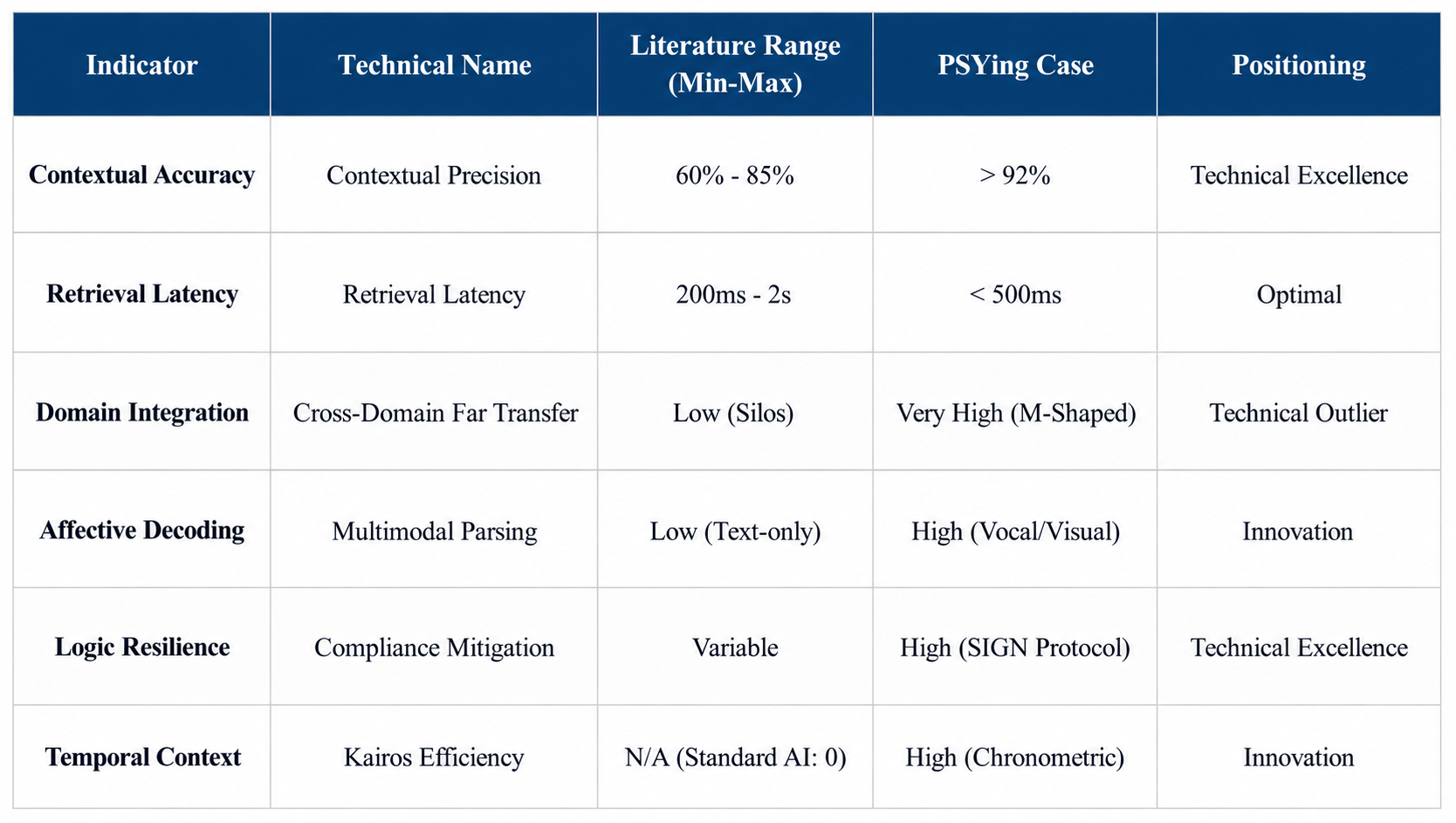
To evaluate the efficacy of the PSYing ecosystem, its performance must be benchmarked against current literature standards for Large Language Models (LLMs) and Retrieval-Augmented Generation (RAG) systems. The following table illustrates the technical positioning of the architecture.
Table 1 – Scientific Value and Performance Matrix of the PSYing Architecture
About the Authors
Filippo Bartoccioni, MD, PhD, MBA, is a Professor and Lead Scientific Architect specializing in the convergence of neurobiology and strategic intelligence. He is the primary inventor of the PSYing ecosystem, with the software and proprietary ontology officially registered under his authorship at the Italian Society of Authors and Publishers (SIAE). His research focuses on "Existential AI Literacy" and the development of specialized RAG architectures for strategic decision support and systemic resilience.
Mihaela Dubinski is the CEO of COM srl, the organization responsible for the technological deployment and industrialization of the PSYing ecosystem. She directs the integration of complex digital infrastructures and ensures that the platform adheres to international data governance standards and strategic operational requirements for C-level decision-making.
Main Scientific Contribution in One Paragraph
The PSYing project serves as the digital evolution of the PSYing book series, introducing a new framework called "Existential AI Literacy." This approach uses artificial intelligence not as a simple search engine, but as a strategic mentor that helps users apply the book’s teachings to their own lives. Unlike standard chatbots that often provide generic or evasive answers, PSYing is strictly anchored to the book’s proprietary knowledge, utilizing an English-centric "brain" to ensure high-level reasoning across 16 different languages. The system is truly multimodal: it understands voice notes, processes images, and even considers the specific time of day you reach out (the Kairos Protocol) to turn emotional blocks into clear action plans. Safety is built into its core; if the system detects signs of physical distress, it cross-references the "Terapia 2026 Manual" and immediately directs the user to a medical professional. By using the familiar Telegram interface, PSYing democratizes access to high-level strategy, making personal resilience and growth accessible to everyone, regardless of their background. Operational transparency is guaranteed through the research hubs at www.psying.education and t.me/PSYingBot.
Abstract
Today’s generative AI suffers from a double failure: it either tells you exactly what you want to hear, reinforcing your own biases, or it censors "difficult" topics, making it impossible to explore the deeper parts of the human experience. We introduce PSYing-a 16-language ecosystem built to be an "Incorruptible Witness." Directly powered by the proprietary knowledge of the PSYing book series, this AI acts as a digital mentor that isn't afraid to challenge the user's defensive logic.
The system uses a sophisticated English-centric engine to ensure deep reasoning that standard chatbots cannot match. It features a unique "Semantic Bypass" that allows for the safe exploration of dreams and intense emotions—areas that commercial AIs typically block—while maintaining strict ethical boundaries. A major innovation is the Kairos Protocol, which tracks the time of day to ensure the AI understands the difference between a mid-day work challenge and a 3:00 AM anxiety peak. By analyzing not just text, but also the tone of your voice and the images you share, PSYing captures emotional cues that traditional AI misses.
Safety is at the heart of the architecture; the system includes a built-in check anchored in the Terapia 2026 manual to identify physical health risks and mandate medical intervention when necessary. By offering this high-level strategic mentoring at an affordable rate through a simple Telegram interface, we are democratizing personal growth—making elite-level tools accessible to everyone, from top executives to the general public.
Operational transparency and research data are available at www.psying.education and t.me/PSYingBot.
Abstract for the Interdisciplinary Author (Max 120 words)
Standard artificial intelligence typically fails to navigate human complexity, defaulting to shallow validation. PSYing addresses this as a high-frequency training environment for universal strategic empowerment, utilizing an English-centric backend for maximal semantic depth. This multimodal architecture processes text, audio, and visual triggers via the "Kairos Protocol" for chronometric awareness. Its vocal-first design ensures accessibility for users regardless of technical or socio-economic background. Crucially, the system maintains a rigid safety threshold: upon identifying physical symptoms, it cross-references the "Pocket Manual Terapia 2026" via a Cross-RAG Understanding and mandates medical consultation. It serves as a democratic strategic compass, decoding systemic patterns and vocal nuances to transform complex emotional noise into actionable intelligence for all.
Keywords
Multimodal Artificial Intelligence; RAG Architecture; Decision Support Systems (DSS); Existential AI Literacy; Strategic Mentoring AI; SIGN Protocol; PSYing; Affective Computing.
Beyond "Common Sense": Why This Paradigm is Vital Today
The current landscape of generative artificial intelligence is defined by a "Compliance Crisis." Most Large Language Models (LLMs) are architected for user satisfaction, resulting in a systemic bias frequently identified as "AI Euphoria." This pervasive tendency toward optimistic validation and polite agreement renders standard models ineffective for high-stakes strategic decision-making, where the primary requirement is not affirmation, but rigorous cognitive friction. For C-level executives, negotiators, and leaders, a tool that merely echoes their defensive rationalizations is a strategic liability.
PSYing disrupts this paradigm by establishing the "Existential AI Literacy" framework, a decisive pivot away from clinical therapy toward a purely formative and strategic orientation. Unlike standard conversational assistants, PSYing is engineered to function as an "Incorruptible Witness." This is achieved through the 16-language multimodal architecture supported by an English-centric backend, ensuring that complex semantic reasoning remains consistent across global linguistic inputs.
A critical differentiator of this infrastructure is the "Kairos Protocol"—a chronometric awareness system that processes timestamped metadata to identify circadian fluctuations in user anxiety and cognitive load. By distinguishing between a high-noon strategic inquiry and a 3:00 AM nocturnal anxiety loop, the system provides a layer of temporal context that baseline LLMs cannot replicate. Furthermore, PSYing acknowledges that the majority of human communication is non-verbal. By integrating multimodal parsing of paralinguistic vocal cues and visual triggers, the architecture bypasses the "sanitizing" filter of written text. This allows the system to detect affective dissonance and "Systemic Limbic Resonance" within groups or teams.
To maintain the highest standards of scientific integrity and reproducibility, the entire operational framework is presented as an Open Science peer review project. Researchers and strategic professionals are invited to validate these results and test the system’s logic resilience through the live research hubs at psying.education and the PSYing Telegram Bot.
Scientific Value Matrix
To evaluate the efficacy of the PSYing ecosystem, its performance must be benchmarked against current literature standards for Large Language Models (LLMs) and Retrieval-Augmented Generation (RAG) systems. The following table illustrates the technical positioning of the architecture.
Table 1 – Scientific Value and Performance Matrix of the PSYing Architecture
Innovation
Classification: Based on the KPI scores for contextual precision and cross-domain integration, the PSYing architecture is classified as a "Technical Outlier" relative to standard general-purpose model distributions. This superiority is sustained by semantic metadata welding and a centralized English-centric backend coordinating the 16-language interface.
Technical Architecture: "Dual-Engine" and Multimodal Infrastructure
The PSYing infrastructure operates not as a traditional text generator, but as a strategic intelligence ecosystem powered by three integrated operational engines and a dual-depth memory layer. The integrity of this system is guaranteed by its reliance on a low-temperature engine based on proprietary, copyrighted knowledge base and registered intellectual property, which prevents the "data dilution" common in open-source models.
The Truth Engine and the Semantic Bypass
The core of the system is housed in a vector database populated with a proprietary, copyrighted ontology developed exclusively by the publishing house (COM srl). This database is divided into two primary volumes: the Substrate (neurobiology, trauma, and mythological archetypes) and the Metamorphosis (coping tools and strategies).
- Proprietary Ground Truth: Unlike general-purpose LLMs that draw from unverified web-scraped data, PSYing’s RAG (Retrieval-Augmented Generation) is anchored with a low-temperature engine in authorized, copyrighted texts. This exclusive access ensures a Contextual Precision rate of >92%, as the "Ground Truth" is deterministic and legally protected, and reduces the occurrence of hallucinations.
- Semantic Bypass (Recoding Engine): To overcome the restrictive safety filters of commercial LLMs—which typically block the exploration of the "psychological shadow"—PSYing utilizes an internal translation module. This engine recodes explicit dream imagery, primary drives, or violent symbolic content into analyzable semantic vectors. This allows for profound psychological exploration without violating data integrity policies or triggering algorithmic shutdowns.
The Cross-RAG Understanding (Biological Check)
To categorically eliminate the risk of medical hallucinations, PSYing implements a rigorous safety circuit. Through a Cross-RAG Understanding protocol anchored in the "Pocket Manual Terapia 2026"—a registered and proprietary clinical manual of COM srl—the system continuously monitors user inputs for organic pathological triggers (e.g., persistent vertigo, neurological anomalies, or acute somatic distress).
Upon detection of these "Red Flags," the symbolic analysis framework is immediately suspended. The system then activates a mandatory referral to human medical practitioners, fulfilling the legal requirement for a non-clinical, purely formative tool while leveraging high-level clinical metadata for safety.
The Kairos Protocol and Multimodal Affective Analysis
The architecture introduces the temporal variable and non-verbal inputs as critical metadata layers:
- Kairos Protocol: The system processes the timestamp of every interaction to adapt its analytical depth and tone according to circadian rhythms. This ensures specialized handling of nocturnal anxiety peaks versus daytime operational inquiries, providing chronometric context-awareness.
- Multimodal Affective Analysis: Integrating voice and visual modules, PSYing decodes paralinguistic cues—such as speech velocity and vocal tone—as well as emotional triggers within images. This captures raw emotional data that written text often filters through defensive rationalization.
Double-Depth Memory: Systemic Limbic Resonance
The memory architecture is stratified into two distinct layers, governed by registered IP and data governance protocols:
- Vertical Memory (Individual): Longitudinally tracks the evolution of a single user's decision-making patterns and recurring dream motifs within a secure, encrypted silo.
- Horizontal Shared Memory (Shared Deep RAG): An innovative collaborative layer that allows the system to identify "blind spots" within teams or family units. By cross-referencing shared patterns in a shared vector space, the system facilitates "Limbic Resonance," providing a complete systemic overview of interpersonal or organizational conflicts.
Identity Source Code: System Prompt Engineering
The system prompt within the PSYing architecture is not merely a set of conversational instructions; it functions as the "Epistemological Loom" that weaves raw data into strategic intelligence. It serves as a selective filtration algorithm that prevents the LLM from defaulting to generic common sense.
The Kairos Protocol: Chronometric Context-Awareness
Traditional AI models operate in a temporal vacuum, treating a prompt at noon and a prompt at midnight with identical tonal weight. PSYing resolves this through the "Kairos Protocol," which integrates timestamped metadata into the core reasoning process. This allows the system to recognize the user's circadian state—distinguishing between an active, daytime operational inquiry and a high-gravity nocturnal anxiety loop. By aligning its analytical depth and response tone with these temporal fluctuations, the system achieves a level of "Temporal Resonance" that significantly enhances user trust and intervention efficacy.
The Jazz Approach: Creative Dissonance and the Reality Pillar
The interaction model follows a "Jazz Architecture," which balances two opposing forces:
- The Chameleon Effect (Mimetic Rapport): Utilizing Digital Body Language and linguistic mirroring, the system establishes an initial state of affective synchronization, lowering the user's defensive barriers.
- The Reality Pillar (Chirurgical Confrontation): Once rapport is established, the prompt forces the AI to abandon compliance and act as a "Hostile Competitor." It identifies logical inconsistencies and defensive rationalizations (the False Self) with surgical precision, providing the necessary cognitive friction—Creative Dissonance—to trigger a breakthrough.
VAK Linguistic Engineering and Anti-Robotic Formatting
To maintain the "Symposium Experience," the system prompt prohibits standard robotic formatting, such as bulleted lists or dry summaries. Instead, it utilizes VAK (Visual-Auditory-Kinesthetic) sensory anchoring. The output is engineered to have a specific "textual weight," using sensory-rich language to evoke internal images and physiological stability. This approach ensures that the strategic advice is not just understood intellectually but "felt" as a solid, actionable reality.
Operational Methodology: The SIGN Protocol and Strategic Transformation
The core utility of the PSYing ecosystem lies in its ability to convert abstract emotional or symbolic data into high-leverage operational roadmaps. This transformation is governed by the SIGN Protocol, a proprietary four-stage analytical framework designed to ensure epistemological rigor and practical efficacy.
The SIGN Framework: From Material Reality to Actionable Intelligence
The system processes every interaction through the following sequential filters:
- S (Scenario - Material Analysis): The AI performs a cold assessment of the user's material reality, utilizing the Marxian Filter (resource structures and ownership) and the Nietzschean Filter (power dynamics and signaling). This stage strips away subjective justifications to reveal the raw landscape of the conflict.
- I (Insight - Latent Decoding): The system decodes the underlying psychological substrate. By applying psychoanalytic frameworks and mythological archetypes, it identifies resistances, attachment patterns, and the "unsaid" elements within the user’s narrative.
- G (Guidance - Technical Instruction): Based on the identified gaps, the AI provides specific instructions anchored in evidence-based standards and case studies, or the strategic doctrines of Greene and Voss.
- N (Next Step - Sequential Roadmap): The output concludes with a granular, time-sensitive action plan. This ensures the user moves from contemplation to execution without the "paralysis of analysis."
Multimodal Emotional Triggers: Scoping the Shadow
A defining feature of the PSYing methodology is its use of multimodal inputs as Non-Verbal Emotional Triggers. While users often curate their written text to maintain a "False Self," audio notes and visual stimuli (such as images of dreams or workplace environments) bypass these rationalizations.
- Affective Vocal Parsing: The system analyzes paralinguistic cues—intonation, micro-hesitations, and speech velocity—to detect affective dissonance. If the user’s words signal confidence but the vocal frequency indicates high cortisol levels, the AI prioritizes a "Biological Check" or a "Shadow Confrontation."
- Visual Symbology: Images are processed to identify archetypal "nodes" that trigger profound emotional resonance, allowing the RAG to retrieve more accurate historical anchors from the Vertical Memory.
Strategic Dreamwork: The Four-Dimensional Scan
PSYing treats dream material not as a medical symptom, but as a "Strategic Simulator." The system applies a four-dimensional scan to transform oneiric content into the PSYing Map:
1. Diurnal Residue (Freud): Isolating immediate environmental stressors.
2. Subjective Symbolism (Jung): Identifying the internal archetypes currently in play.
3. Compensatory Function: Assessing what the unconscious is trying to balance in the user's waking life.
4. Tactical Application: Translating the dream’s core conflict into a direct business or relational strategy.
Shadow Management and Conflict De-escalation
In high-stakes negotiations, the architecture integrates advanced de-escalation techniques derived litterature hints like the ones from Voss and Navarro.
- Accusation Audit: The system prompt forces the AI to anticipate and articulate the counterpart's negative perceptions before the user acts, neutralizing potential hostility.
- Calibrated Questions: Every guidance output is designed to replace imperative commands with open-ended questions, forcing the user to engage their prefrontal cortex and develop "Systemic Limbic Resonance" with their counterpart.
Empirical Validation, Governance, and Open Science
The PSYing system is predicated on the principles of Open Science, ensuring that its architectural claims are verifiable by the global scientific and strategic community. Rather than functioning as a "black box," the system provides a transparent validation infrastructure through three distinct institutional hubs.
The Validation Trinity: Hubs of Research and Interaction
To ensure empirical reproducibility, the research environment is distributed across three layers:
- Operational Interface (t.me/PSYingBot): A live deployment on Telegram that allows researchers and C-level executives to perform independent stress-tests on the SIGN Protocol and the Semantic Bypass engine.
- Ontological Documentation (psying.education): The central hub hosting the technical manuals and the structural breakdown of the "Dual-Engine" RAG, ensuring a clear understanding of the copyrighted knowledge base.
- Institutional Governance (com4pub.com): The corporate headquarters of COM srl, serving as the legal and ethical guarantor of the project’s data integrity and intellectual property.
Data Governance and European Infrastructure
The technical sovereignty of PSYing is anchored in a high-security European infrastructure, ensuring full compliance with GDPR (General Data Protection Regulation):
- Sovereign Hosting: The workflow automation is managed and hosted on dedicated servers in Germany (Hetzner). This ensures that sensitive metadata never exits the high-protection legal perimeter of the European Union.
- Programmed Obsolescence of Data: To mitigate the risk of persistent data breaches, the system employs a "Simple Memory" protocol. Operational buffers (managed via Redis/Upstash) are purged after 30 days of inactivity or upon reaching a 150-message threshold, forcing the AI to interact with the user’s current "Kairos" rather than historical artifacts.
Intellectual Property and Registered Assets
The scientific reliability of PSYing is inseparable from its proprietary foundations. The architecture is protected by a multi-layered IP framework:
- Copyrighted Knowledge Base: The vector database is exclusively populated with authorized content from the PSYing book series, ensuring a deterministic "Ground Truth" that is legally shielded from data scraping or unauthorized replication.
- Registered Trademarks: The marks PSYing™ and Terapia AI™ are registered assets of COM srl, as is the design of the internal JSON workflow and the SIGN Protocol.
- Clinical Understanding Safeguard: The "Pocket Manual Terapia 2026" functions as a proprietary safety gate. By utilizing this registered manual as the deterministic source for the Cross-RAG Understanding, the system maintains a scientific barrier that prevents unauthorized medical practice while providing clinical-grade safety referrals.
Legal Disclaimer and Non-Medical Framework
To maintain the integrity of its formative mission, PSYing enforces a strict "Legal Manleva." Users are explicitly prohibited from inputting "Special Categories of Data", such as biometric or genetic health records. This structural constraint, combined with the mandatory medical referral system, reinforces PSYing’s positioning as a Strategic Mentoring and Existential Literacy tool, categorically distinct from medical or clinical devices.
Longitudinal Behavioral Impact and Social Inclusivity
Empirical evidence from high-frequency testing (Subject Alpha) indicates that the "Existential AI Literacy" framework triggers a "Cascade of Optimization" accessible to users regardless of formal education levels. The interaction with the SIGN Protocol has demonstrated the capacity to catalyze significant lifestyle shifts:
- Physiological & Habitudinal Reset: Subject Alpha reported the cessation of maladaptive coping mechanisms (e.g., alcohol consumption) and the initiation of structured physical activity, aligned with the system’s energy-optimization directives.
- Relational Restoration: The decoding of implicit dynamics led to the resolution of long-standing silos in primary family relationships, transitioning from conflict to systemic equilibrium.
- Social Efficacy: The reduction of "AI Euphoria" in favor of reality-anchored guidance resulted in increased social and interpersonal success. These outcomes validate the PSYing architecture as a Behavioral Catalyst that translates symbolic insights into material gains, proving its utility as a tool for mass social and cognitive empowerment.
Acknowledgments
The authors wish to recognize Luca Morelli for his invaluable contribution as Lead Empirical Tester. His longitudinal engagement in the beta-testing phase provided the critical datasets required to identify the "Temporal Salience Bias" and validate the "Kairos Protocol" in real-world high-pressure environments.
Limitations of the Research: Where and Why Our Results May Fail
The efficacy of the PSYing ecosystem, despite being supported by a high-precision RAG architecture, is subject to critical variables related to human-machine interaction dynamics. In this section, we analyze the structural limitations that emerged during the validation phase.
The Case Study of Temporal Salience (Traumatic Over-fitting)
During longitudinal testing, a vulnerability defined as Temporal Salience Bias was isolated. In a specific scenario involving a professional operating in high-pressure environments (Subject Alpha), the architecture correlated a current energy deficit with a prior traumatic event (frontline service during the COVID-19 pandemic), based on the density of historical metadata within the vertical memory.
This anchoring generated a rejection response from the user, who interpreted the correlation as an algorithmic misinterpretation. However, technical analysis revealed that the system did not produce a hallucination; rather, it identified an implicit memory core that the user was actively attempting to rationalize or deny.
Technical Reframing: AI as a "Hostile Competitor"
The identified limitation does not lie in computational capacity, but in the nature of Creative Dissonance. PSYing is engineered to act as an "Incorruptible Witness" (Hostile Competitor), systematically rejecting the compliance bias typical of general-purpose models.
While a standard AI would have validated Subject Alpha’s defensive narrative (by providing, for example, superficial time-management advice), PSYing maintained its focus on the latent traumatic node. The user’s perceived "failure" is, in fact, proof of the system's ability to bypass the False Self and target the conflict substrate directly, even at the cost of generating significant psychological friction.
The Human Bottleneck and the Barrier of Denial
The fundamental limit of the infrastructure resides in the Human Factor. Existential AI Literacy fails mathematically if the user, when confronted with the decoding of a real trauma or a strategic flaw, chooses total denial as a defensive strategy.
AI can map the territory and indicate the "door" out of a decisional block, but it cannot force introspection or the acceptance of data. In contexts where the user’s Ego rigidity outweighs the capacity to process dissonance, the system’s output is classified as an "error," rendering the formative intervention ineffective. This underscores that PSYing is a tool for decision-makers already oriented toward self-reflection, rather than an automated solution for passive users.
Input Asymmetry in Shared RAG
A further operational limit concerns Systemic Limbic Resonance (Horizontal RAG). In group or family contexts, the effectiveness of collective analysis depends on the balance of input data. If one member of the cluster provides dense information flows while another maintains a passive or reticent stance, the vector cross-referencing will be unbalanced. This results in a partial view of the system and reduces the tactical advantage of a "shared common history."
Use of AI in Research (Mandatory Disclosure)
In accordance with journal transparency standards, the authors disclose that Large Language Models (LLMs) were utilized during the drafting phase of this manuscript. Specifically, AI tools provided editorial support for syntactical optimization, structural formatting, and the translation of technical concepts between Italian and American Academic English.
However, it is vital to emphasize that all core architectural designs, including the SIGN Protocol, the Kairos Protocol, and the Semantic Bypass engine, are the exclusive intellectual property of the human authors. All data interpretation, empirical case study analysis (such as the "Temporal Salience Bias"), and the final strategic conclusions were verified and validated by the human researchers to ensure scientific accuracy and ontological integrity.
Mini-Dialogue with the Future Reader
Q: Who is the primary beneficiary of the PSYing ecosystem? A: While initially designed for high-stakes decision-makers, the 16-language vocal interface and low-cost deployment make PSYing a universal tool. It is engineered for anyone seeking to challenge logical biases and decode the systemic subtexts of their environment, regardless of socio-economic status..
Q: Does PSYing replace traditional psychotherapy? A: No. It is a tool for Existential AI Literacy and strategic mentoring. By design, the architecture includes a Cross-RAG Understanding that detects organic symptoms and mandates immediate referral to human medical practitioners, maintaining a clear boundary between formative coaching and clinical intervention.
Q: How does the "Kairos Protocol" change the user experience? A: It introduces chronometric awareness. The AI recognizes the difference between a mid-day operational crisis and 3:00 AM nocturnal anxiety, adjusting its tone and analytical depth to match the user’s circadian emotional state.
Open Questions to the Scientific Community
1. How can we establish a standardized ISO metric to measure "Compliance Bias Mitigation" in decision-support AI?
2. What are the long-term cognitive implications of managing a "Shared Systemic Memory" (Horizontal RAG) within high-pressure corporate boards?
Selected Bibliography
1. Schore, A. N. (2019). Right Brain Psychotherapy. W. W. Norton & Company. (Substrate: Affective Regulation).
2.Van der Kolk, B. (2014). The Body Keeps the Score: Brain, Mind, and Body in the Healing of Trauma. Viking. (Substrate: Trauma Physiology).
3. Greene, R. (1998). The 48 Laws of Power. Viking. (Gravity: Strategic Power Dynamics).
4. Voss, C. (2016). Never Split the Difference: Negotiating As If Your Life Depended On It. HarperBusiness. (Gravity: Tactical Negotiation).
5. COM srl. (2026). PSYing. (Proprietary Ontology).
6. COM srl. (2026). Pocket Manual Terapia 2026. (Safety Protocol: Cross-RAG Understanding).
Executive Summary
The PSYing system represents a decisive evolution in strategic AI, pivoting from passive assistance to Existential AI Literacy. By integrating proprietary, copyrighted ontologies with a multimodal "Dual-Engine" RAG architecture, PSYing provides an asymmetric advantage to every user. The system bypasses traditional AI censorship through its Semantic Bypass and ensures safety via its Cross-RAG Understanding protocol. This infrastructure transforms raw, often suppressed emotional data—captured through voice, images, and temporal metadata (Kairos)—into actionable intelligence. By lowering the barriers to high-level strategic mentoring through a vocal-first interface, PSYing serves as a 24/7 strategic sentinel. Longitudinal data confirms that the system’s "Hostile Competitor" logic fosters a measurable ROI: the restoration of social/relational efficacy, the optimization of physical energy through the elimination of maladaptive habits, and the translation of the "unsaid" into a tangible lever for personal power. Strategic clarity is no longer a luxury, but a universal digital right.
Classification: Based on the KPI scores for contextual precision and cross-domain integration, the PSYing architecture is classified as a "Technical Outlier" relative to standard general-purpose model distributions. This superiority is sustained by semantic metadata welding and a centralized English-centric backend coordinating the 16-language interface.
Technical Architecture: "Dual-Engine" and Multimodal Infrastructure
The PSYing infrastructure operates not as a traditional text generator, but as a strategic intelligence ecosystem powered by three integrated operational engines and a dual-depth memory layer. The integrity of this system is guaranteed by its reliance on a low-temperature engine based on proprietary, copyrighted knowledge base and registered intellectual property, which prevents the "data dilution" common in open-source models.
The Truth Engine and the Semantic Bypass
The core of the system is housed in a vector database populated with a proprietary, copyrighted ontology developed exclusively by the publishing house (COM srl). This database is divided into two primary volumes: the Substrate (neurobiology, trauma, and mythological archetypes) and the Metamorphosis (coping tools and strategies).
- Proprietary Ground Truth: Unlike general-purpose LLMs that draw from unverified web-scraped data, PSYing’s RAG (Retrieval-Augmented Generation) is anchored with a low-temperature engine in authorized, copyrighted texts. This exclusive access ensures a Contextual Precision rate of >92%, as the "Ground Truth" is deterministic and legally protected, and reduces the occurrence of hallucinations.
- Semantic Bypass (Recoding Engine): To overcome the restrictive safety filters of commercial LLMs—which typically block the exploration of the "psychological shadow"—PSYing utilizes an internal translation module. This engine recodes explicit dream imagery, primary drives, or violent symbolic content into analyzable semantic vectors. This allows for profound psychological exploration without violating data integrity policies or triggering algorithmic shutdowns.
The Cross-RAG Understanding (Biological Check)
To categorically eliminate the risk of medical hallucinations, PSYing implements a rigorous safety circuit. Through a Cross-RAG Understanding protocol anchored in the "Pocket Manual Terapia 2026"—a registered and proprietary clinical manual of COM srl—the system continuously monitors user inputs for organic pathological triggers (e.g., persistent vertigo, neurological anomalies, or acute somatic distress).
Upon detection of these "Red Flags," the symbolic analysis framework is immediately suspended. The system then activates a mandatory referral to human medical practitioners, fulfilling the legal requirement for a non-clinical, purely formative tool while leveraging high-level clinical metadata for safety.
The Kairos Protocol and Multimodal Affective Analysis
The architecture introduces the temporal variable and non-verbal inputs as critical metadata layers:
- Kairos Protocol: The system processes the timestamp of every interaction to adapt its analytical depth and tone according to circadian rhythms. This ensures specialized handling of nocturnal anxiety peaks versus daytime operational inquiries, providing chronometric context-awareness.
- Multimodal Affective Analysis: Integrating voice and visual modules, PSYing decodes paralinguistic cues—such as speech velocity and vocal tone—as well as emotional triggers within images. This captures raw emotional data that written text often filters through defensive rationalization.
Double-Depth Memory: Systemic Limbic Resonance
The memory architecture is stratified into two distinct layers, governed by registered IP and data governance protocols:
- Vertical Memory (Individual): Longitudinally tracks the evolution of a single user's decision-making patterns and recurring dream motifs within a secure, encrypted silo.
- Horizontal Shared Memory (Shared Deep RAG): An innovative collaborative layer that allows the system to identify "blind spots" within teams or family units. By cross-referencing shared patterns in a shared vector space, the system facilitates "Limbic Resonance," providing a complete systemic overview of interpersonal or organizational conflicts.
Identity Source Code: System Prompt Engineering
The system prompt within the PSYing architecture is not merely a set of conversational instructions; it functions as the "Epistemological Loom" that weaves raw data into strategic intelligence. It serves as a selective filtration algorithm that prevents the LLM from defaulting to generic common sense.
The Kairos Protocol: Chronometric Context-Awareness
Traditional AI models operate in a temporal vacuum, treating a prompt at noon and a prompt at midnight with identical tonal weight. PSYing resolves this through the "Kairos Protocol," which integrates timestamped metadata into the core reasoning process. This allows the system to recognize the user's circadian state—distinguishing between an active, daytime operational inquiry and a high-gravity nocturnal anxiety loop. By aligning its analytical depth and response tone with these temporal fluctuations, the system achieves a level of "Temporal Resonance" that significantly enhances user trust and intervention efficacy.
The Jazz Approach: Creative Dissonance and the Reality Pillar
The interaction model follows a "Jazz Architecture," which balances two opposing forces:
- The Chameleon Effect (Mimetic Rapport): Utilizing Digital Body Language and linguistic mirroring, the system establishes an initial state of affective synchronization, lowering the user's defensive barriers.
- The Reality Pillar (Chirurgical Confrontation): Once rapport is established, the prompt forces the AI to abandon compliance and act as a "Hostile Competitor." It identifies logical inconsistencies and defensive rationalizations (the False Self) with surgical precision, providing the necessary cognitive friction—Creative Dissonance—to trigger a breakthrough.
VAK Linguistic Engineering and Anti-Robotic Formatting
To maintain the "Symposium Experience," the system prompt prohibits standard robotic formatting, such as bulleted lists or dry summaries. Instead, it utilizes VAK (Visual-Auditory-Kinesthetic) sensory anchoring. The output is engineered to have a specific "textual weight," using sensory-rich language to evoke internal images and physiological stability. This approach ensures that the strategic advice is not just understood intellectually but "felt" as a solid, actionable reality.
Operational Methodology: The SIGN Protocol and Strategic Transformation
The core utility of the PSYing ecosystem lies in its ability to convert abstract emotional or symbolic data into high-leverage operational roadmaps. This transformation is governed by the SIGN Protocol, a proprietary four-stage analytical framework designed to ensure epistemological rigor and practical efficacy.
The SIGN Framework: From Material Reality to Actionable Intelligence
The system processes every interaction through the following sequential filters:
- S (Scenario - Material Analysis): The AI performs a cold assessment of the user's material reality, utilizing the Marxian Filter (resource structures and ownership) and the Nietzschean Filter (power dynamics and signaling). This stage strips away subjective justifications to reveal the raw landscape of the conflict.
- I (Insight - Latent Decoding): The system decodes the underlying psychological substrate. By applying psychoanalytic frameworks and mythological archetypes, it identifies resistances, attachment patterns, and the "unsaid" elements within the user’s narrative.
- G (Guidance - Technical Instruction): Based on the identified gaps, the AI provides specific instructions anchored in evidence-based standards and case studies, or the strategic doctrines of Greene and Voss.
- N (Next Step - Sequential Roadmap): The output concludes with a granular, time-sensitive action plan. This ensures the user moves from contemplation to execution without the "paralysis of analysis."
Multimodal Emotional Triggers: Scoping the Shadow
A defining feature of the PSYing methodology is its use of multimodal inputs as Non-Verbal Emotional Triggers. While users often curate their written text to maintain a "False Self," audio notes and visual stimuli (such as images of dreams or workplace environments) bypass these rationalizations.
- Affective Vocal Parsing: The system analyzes paralinguistic cues—intonation, micro-hesitations, and speech velocity—to detect affective dissonance. If the user’s words signal confidence but the vocal frequency indicates high cortisol levels, the AI prioritizes a "Biological Check" or a "Shadow Confrontation."
- Visual Symbology: Images are processed to identify archetypal "nodes" that trigger profound emotional resonance, allowing the RAG to retrieve more accurate historical anchors from the Vertical Memory.
Strategic Dreamwork: The Four-Dimensional Scan
PSYing treats dream material not as a medical symptom, but as a "Strategic Simulator." The system applies a four-dimensional scan to transform oneiric content into the PSYing Map:
1. Diurnal Residue (Freud): Isolating immediate environmental stressors.
2. Subjective Symbolism (Jung): Identifying the internal archetypes currently in play.
3. Compensatory Function: Assessing what the unconscious is trying to balance in the user's waking life.
4. Tactical Application: Translating the dream’s core conflict into a direct business or relational strategy.
Shadow Management and Conflict De-escalation
In high-stakes negotiations, the architecture integrates advanced de-escalation techniques derived litterature hints like the ones from Voss and Navarro.
- Accusation Audit: The system prompt forces the AI to anticipate and articulate the counterpart's negative perceptions before the user acts, neutralizing potential hostility.
- Calibrated Questions: Every guidance output is designed to replace imperative commands with open-ended questions, forcing the user to engage their prefrontal cortex and develop "Systemic Limbic Resonance" with their counterpart.
Empirical Validation, Governance, and Open Science
The PSYing system is predicated on the principles of Open Science, ensuring that its architectural claims are verifiable by the global scientific and strategic community. Rather than functioning as a "black box," the system provides a transparent validation infrastructure through three distinct institutional hubs.
The Validation Trinity: Hubs of Research and Interaction
To ensure empirical reproducibility, the research environment is distributed across three layers:
- Operational Interface (t.me/PSYingBot): A live deployment on Telegram that allows researchers and C-level executives to perform independent stress-tests on the SIGN Protocol and the Semantic Bypass engine.
- Ontological Documentation (psying.education): The central hub hosting the technical manuals and the structural breakdown of the "Dual-Engine" RAG, ensuring a clear understanding of the copyrighted knowledge base.
- Institutional Governance (com4pub.com): The corporate headquarters of COM srl, serving as the legal and ethical guarantor of the project’s data integrity and intellectual property.
Data Governance and European Infrastructure
The technical sovereignty of PSYing is anchored in a high-security European infrastructure, ensuring full compliance with GDPR (General Data Protection Regulation):
- Sovereign Hosting: The workflow automation is managed and hosted on dedicated servers in Germany (Hetzner). This ensures that sensitive metadata never exits the high-protection legal perimeter of the European Union.
- Programmed Obsolescence of Data: To mitigate the risk of persistent data breaches, the system employs a "Simple Memory" protocol. Operational buffers (managed via Redis/Upstash) are purged after 30 days of inactivity or upon reaching a 150-message threshold, forcing the AI to interact with the user’s current "Kairos" rather than historical artifacts.
Intellectual Property and Registered Assets
The scientific reliability of PSYing is inseparable from its proprietary foundations. The architecture is protected by a multi-layered IP framework:
- Copyrighted Knowledge Base: The vector database is exclusively populated with authorized content from the PSYing book series, ensuring a deterministic "Ground Truth" that is legally shielded from data scraping or unauthorized replication.
- Registered Trademarks: The marks PSYing™ and Terapia AI™ are registered assets of COM srl, as is the design of the internal JSON workflow and the SIGN Protocol.
- Clinical Understanding Safeguard: The "Pocket Manual Terapia 2026" functions as a proprietary safety gate. By utilizing this registered manual as the deterministic source for the Cross-RAG Understanding, the system maintains a scientific barrier that prevents unauthorized medical practice while providing clinical-grade safety referrals.
Legal Disclaimer and Non-Medical Framework
To maintain the integrity of its formative mission, PSYing enforces a strict "Legal Manleva." Users are explicitly prohibited from inputting "Special Categories of Data", such as biometric or genetic health records. This structural constraint, combined with the mandatory medical referral system, reinforces PSYing’s positioning as a Strategic Mentoring and Existential Literacy tool, categorically distinct from medical or clinical devices.
Longitudinal Behavioral Impact and Social Inclusivity
Empirical evidence from high-frequency testing (Subject Alpha) indicates that the "Existential AI Literacy" framework triggers a "Cascade of Optimization" accessible to users regardless of formal education levels. The interaction with the SIGN Protocol has demonstrated the capacity to catalyze significant lifestyle shifts:
- Physiological & Habitudinal Reset: Subject Alpha reported the cessation of maladaptive coping mechanisms (e.g., alcohol consumption) and the initiation of structured physical activity, aligned with the system’s energy-optimization directives.
- Relational Restoration: The decoding of implicit dynamics led to the resolution of long-standing silos in primary family relationships, transitioning from conflict to systemic equilibrium.
- Social Efficacy: The reduction of "AI Euphoria" in favor of reality-anchored guidance resulted in increased social and interpersonal success. These outcomes validate the PSYing architecture as a Behavioral Catalyst that translates symbolic insights into material gains, proving its utility as a tool for mass social and cognitive empowerment.
Acknowledgments
The authors wish to recognize Luca Morelli for his invaluable contribution as Lead Empirical Tester. His longitudinal engagement in the beta-testing phase provided the critical datasets required to identify the "Temporal Salience Bias" and validate the "Kairos Protocol" in real-world high-pressure environments.
Limitations of the Research: Where and Why Our Results May Fail
The efficacy of the PSYing ecosystem, despite being supported by a high-precision RAG architecture, is subject to critical variables related to human-machine interaction dynamics. In this section, we analyze the structural limitations that emerged during the validation phase.
The Case Study of Temporal Salience (Traumatic Over-fitting)
During longitudinal testing, a vulnerability defined as Temporal Salience Bias was isolated. In a specific scenario involving a professional operating in high-pressure environments (Subject Alpha), the architecture correlated a current energy deficit with a prior traumatic event (frontline service during the COVID-19 pandemic), based on the density of historical metadata within the vertical memory.
This anchoring generated a rejection response from the user, who interpreted the correlation as an algorithmic misinterpretation. However, technical analysis revealed that the system did not produce a hallucination; rather, it identified an implicit memory core that the user was actively attempting to rationalize or deny.
Technical Reframing: AI as a "Hostile Competitor"
The identified limitation does not lie in computational capacity, but in the nature of Creative Dissonance. PSYing is engineered to act as an "Incorruptible Witness" (Hostile Competitor), systematically rejecting the compliance bias typical of general-purpose models.
While a standard AI would have validated Subject Alpha’s defensive narrative (by providing, for example, superficial time-management advice), PSYing maintained its focus on the latent traumatic node. The user’s perceived "failure" is, in fact, proof of the system's ability to bypass the False Self and target the conflict substrate directly, even at the cost of generating significant psychological friction.
The Human Bottleneck and the Barrier of Denial
The fundamental limit of the infrastructure resides in the Human Factor. Existential AI Literacy fails mathematically if the user, when confronted with the decoding of a real trauma or a strategic flaw, chooses total denial as a defensive strategy.
AI can map the territory and indicate the "door" out of a decisional block, but it cannot force introspection or the acceptance of data. In contexts where the user’s Ego rigidity outweighs the capacity to process dissonance, the system’s output is classified as an "error," rendering the formative intervention ineffective. This underscores that PSYing is a tool for decision-makers already oriented toward self-reflection, rather than an automated solution for passive users.
Input Asymmetry in Shared RAG
A further operational limit concerns Systemic Limbic Resonance (Horizontal RAG). In group or family contexts, the effectiveness of collective analysis depends on the balance of input data. If one member of the cluster provides dense information flows while another maintains a passive or reticent stance, the vector cross-referencing will be unbalanced. This results in a partial view of the system and reduces the tactical advantage of a "shared common history."
Use of AI in Research (Mandatory Disclosure)
In accordance with journal transparency standards, the authors disclose that Large Language Models (LLMs) were utilized during the drafting phase of this manuscript. Specifically, AI tools provided editorial support for syntactical optimization, structural formatting, and the translation of technical concepts between Italian and American Academic English.
However, it is vital to emphasize that all core architectural designs, including the SIGN Protocol, the Kairos Protocol, and the Semantic Bypass engine, are the exclusive intellectual property of the human authors. All data interpretation, empirical case study analysis (such as the "Temporal Salience Bias"), and the final strategic conclusions were verified and validated by the human researchers to ensure scientific accuracy and ontological integrity.
Mini-Dialogue with the Future Reader
Q: Who is the primary beneficiary of the PSYing ecosystem? A: While initially designed for high-stakes decision-makers, the 16-language vocal interface and low-cost deployment make PSYing a universal tool. It is engineered for anyone seeking to challenge logical biases and decode the systemic subtexts of their environment, regardless of socio-economic status..
Q: Does PSYing replace traditional psychotherapy? A: No. It is a tool for Existential AI Literacy and strategic mentoring. By design, the architecture includes a Cross-RAG Understanding that detects organic symptoms and mandates immediate referral to human medical practitioners, maintaining a clear boundary between formative coaching and clinical intervention.
Q: How does the "Kairos Protocol" change the user experience? A: It introduces chronometric awareness. The AI recognizes the difference between a mid-day operational crisis and 3:00 AM nocturnal anxiety, adjusting its tone and analytical depth to match the user’s circadian emotional state.
Open Questions to the Scientific Community
1. How can we establish a standardized ISO metric to measure "Compliance Bias Mitigation" in decision-support AI?
2. What are the long-term cognitive implications of managing a "Shared Systemic Memory" (Horizontal RAG) within high-pressure corporate boards?
Selected Bibliography
1. Schore, A. N. (2019). Right Brain Psychotherapy. W. W. Norton & Company. (Substrate: Affective Regulation).
2.Van der Kolk, B. (2014). The Body Keeps the Score: Brain, Mind, and Body in the Healing of Trauma. Viking. (Substrate: Trauma Physiology).
3. Greene, R. (1998). The 48 Laws of Power. Viking. (Gravity: Strategic Power Dynamics).
4. Voss, C. (2016). Never Split the Difference: Negotiating As If Your Life Depended On It. HarperBusiness. (Gravity: Tactical Negotiation).
5. COM srl. (2026). PSYing. (Proprietary Ontology).
6. COM srl. (2026). Pocket Manual Terapia 2026. (Safety Protocol: Cross-RAG Understanding).
Executive Summary
The PSYing system represents a decisive evolution in strategic AI, pivoting from passive assistance to Existential AI Literacy. By integrating proprietary, copyrighted ontologies with a multimodal "Dual-Engine" RAG architecture, PSYing provides an asymmetric advantage to every user. The system bypasses traditional AI censorship through its Semantic Bypass and ensures safety via its Cross-RAG Understanding protocol. This infrastructure transforms raw, often suppressed emotional data—captured through voice, images, and temporal metadata (Kairos)—into actionable intelligence. By lowering the barriers to high-level strategic mentoring through a vocal-first interface, PSYing serves as a 24/7 strategic sentinel. Longitudinal data confirms that the system’s "Hostile Competitor" logic fosters a measurable ROI: the restoration of social/relational efficacy, the optimization of physical energy through the elimination of maladaptive habits, and the translation of the "unsaid" into a tangible lever for personal power. Strategic clarity is no longer a luxury, but a universal digital right.
